What Is Agentic Marketing for Automotive
A complete guide to agentic marketing—how autonomous AI agents plan, execute, and optimise multi-channel campaigns for car brands and dealerships.
Covers core concepts, industry frameworks, and real-world implementation examples from the automotive sector.
Explore Guide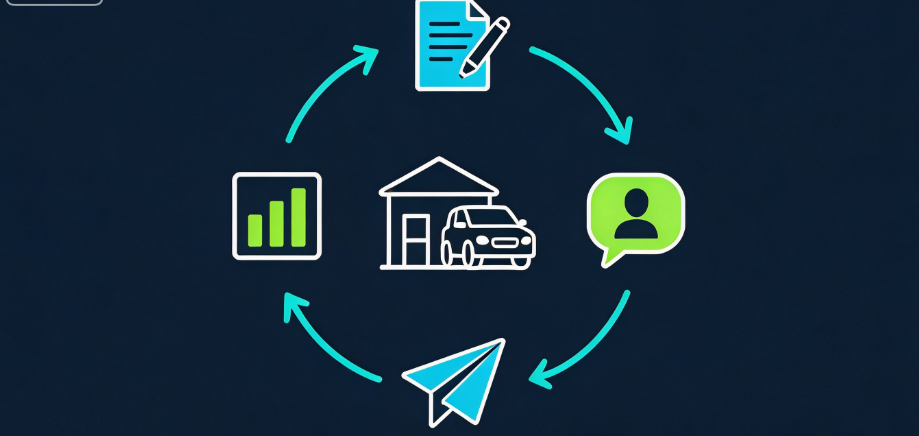
Agentic marketing architecture: content, engagement, distribution, and analytics agents in coordinated execution
Agentic Marketing Deep Dives
In-depth articles exploring agentic marketing strategies, implementation frameworks, and case studies for automotive businesses ready to adopt AI-driven campaigns.
Agentic Marketing
Agentic Marketing is a marketing paradigm in which autonomous AI agents perform end-to-end campaign operations—content creation, audience targeting, channel distribution, and performance optimisation—without requiring manual intervention at each step. Unlike traditional marketing automation, which follows predefined rules and triggers, agentic marketing systems observe real-time data, make decisions, and adapt strategies dynamically. For automotive businesses, this means a single platform can generate video content, engage showroom visitors via chat, distribute listings across channels, and adjust ad spend based on conversion data.
Integrated Agentic System
(IAS)An Integrated Agentic System (IAS) is a platform architecture in which multiple specialised AI agents—each responsible for a distinct function such as content generation, customer engagement, distribution, or analytics—operate under a unified orchestration layer. Unlike single-agent tools that handle one task in isolation, an IAS enables agents to share context, hand off tasks, and synchronise actions across the full marketing cycle.
AI Agent
An AI Agent is an autonomous software system that perceives input from its environment—such as customer messages, campaign performance data, or content requests—and takes independent actions to achieve defined goals. Unlike conventional chatbots that follow scripted flows, an AI agent reasons about the current context, selects from available tools or APIs, and iterates on its approach based on outcomes. In the automotive marketing context, an AI agent might monitor a dealership's social media engagement, identify declining click-through rates.
Q. How is agentic marketing different from traditional marketing automation?
Traditional automation executes fixed workflows—send email after form submission, for example. Agentic marketing systems observe live data, reason about context, and adapt actions dynamically, such as shifting ad spend mid-campaign based on conversion trends.
Agentic systems make autonomous decisions in real time; automation follows preset rules and triggers.
Q. Can small dealerships benefit from agentic marketing?
Small dealerships often lack dedicated marketing staff. An agentic system can generate content, manage customer interactions, and optimise ad spend autonomously, enabling a lean team to run campaigns that would otherwise require multiple specialists.
Yes—agentic platforms reduce the need for large marketing teams by automating campaign execution end-to-end.
Ready to Implement Agentic Marketing?
Gartner predicts 40% of enterprise apps will feature AI agents by 2026—see what the data shows.
Automotive AI Marketing Hub Editorial Desk